Thursday, 14 June 2012

Vegas Baby, Vegas!

For me, Vegas epitomizes what went wrong with modern western capitalist society. Rampant consumerism, greed and predatory marketing all wrapped up in an environmentally unsustainable package. The only thing I like about Vegas is it may be the least prudish city I've ever visited.

Today I visited Vegas for the first time. Today I drove from Pahrump Nevada to Las Vegas Nevada, slightly less than 65 miles. Here's the map.


I started my day collecting rocks in the Spring Range just northeast of Pahrump. I had preselected this location based on satellite imagery and maps (as I did for all my locations) and was pleasantly surprised that the road I intended to use went far further into the mountains than I had anticipated. Less walking!

Roadrunner Road started out a benign gravel track but very quickly got interesting. Several steep, although short, twisty climbs with high potential for getting cross axled added interest. On the way down several of these sections I was on three wheels. The road eventually gave way to a gravelly wash which narrowed as it entered the rocks I was there to sample! I had to quit at the first real obstacle as with no spotter a misplaced wheel could result in a real test of my rock sliders. Also if I broke something or got stuck I was on my own, never a good thing. Here's a photograph of the Neoproterozoic Stirling Quartzite and the obstacle that thwarted me.


After sampling the Sterling Quartzite and the overlying Middle Member of the Wood Canyon Formation (MMWC) I made the short drive to Las Vegas.  I decided I couldn't drive through Vegas without seeing the strip so I exited the interstate and drove the entire length of the strip. It was everything I expected it would be.

My sample location was on the northeast of Vegas on the flanks of Frenchman Mountain. Normally I have to do some geological sleuthing to ensure I'm looking at the correct rocks. At Frenchman Mountain somebody had put signs up, creating a small geological tour, with the formation names on them. Very handy. Here's the sign telling me I'd found the Tapeats Sandstone, the formation I was here to sample, complete with an environmental interpretation.


Here's a shot of the usual unconformity between crystalline basement and the overlying Tapeats Sandstone. The hill in the foreground on the right is crystalline. The left hill is Tapeats. Las Vegas is in the background.


After doing my sampling I drove through Frenchman Mountain to Lake Mead, where I camped for the night. Lake Mead is the largest reservoir in the United States by volume and was created in 1936 with the completion of the Hoover Dam. Recently drought conditions in the western US has resulted in a dramatic drop in lake levels. The lake is currently about 110 feet below normal capacity and studies have suggested that if current water usage and precipitation trends continue the reservoir will need to be retired by 2021. Here's a shot of the reservoir from one of the many viewpoints. The light tan areas in the foreground are areas exposed by the drought.


I camped at the Boulder Beach campground in Lake Mead National Recreation Area. I befriended and cooked dinner for a cyclist who was making his way around the western US. Turns out he was from France and spoke very litte english. Thankfully I speak french so we had a delightful dinner and then went to Boulder City, Nevada to use the WIFI at the local Starbucks.

Tomorrow I'm off to Utah. Cricket Range and then to Fillmore. Hopefully I will be able to update you from there.

Tuesday, 12 June 2012

Dunes and Cinder Cones, Mohave National Preserve


With a hot miserable night at the foot of the Marble Mountains behind me I decided to relax a bit today. I had a relatively short drive to do, from Southern California to Pahrump, Nevada, a measly 162 miles through the heart of the Mohave Desert. Kelbaker Road cuts through the western Mohave National Preserve and provides the most direct route from Cadiz to Pahrump. Along the way I took in the Kelso Dunes and the Quaternary-Pleistocene Cima Volcanic Field. (June 11, 2012)


The Kelso Dunes rise about 200m out of the desert. I decided to walk to the crest of the dune field’s east end. When you leave your car you feel that the dunes are right there with nothing providing any sort of perspective. I was tempted to not even bring water, thinking it would be a short hike. Thankfully I thought better of it and put some food and water into my backpack and set off. Coincidentally a group of multitalented individuals from Joshua Tree departed the parking lot at the same time and we discussed life in Joshua Tree while we walked. Apparently people in Joshua Tree “do what’s needed to get by”. This group held more odd jobs then I have had in my life.
About an hour and fifteen minutes and a litre of water later, I was on the crest of the dune, sans Joshua Tree friends who turned back after 20 minutes. Wow, that was a lot of work. Here are the dunes from near the highway.


As I walked up toward the dunes I was amazed at the assortment of tracks left by animals in the sand. Here’s a selection.

This one was quite recognizable as the trail of a small Sidewinder, a type of rattlesnake that moves sideways.


As I gained elevation on the dune the views got more impressive. The perfectly smooth curvature of this ridge captivated me for some time.


Shortly after taking this picture I set off a small avalanche of sand down the lee side of the dune. The small avalanche spread to incorporate 25’ of the dune crest, moving to a depth of 3”. The moving sand made a sound reminiscent of a jet aircraft on approach to an airport. That peculiar sound you get when they open their flaps up. Until I realized what it was it was a bit disconcerting. The sound persisted for about 15 seconds, the duration of the avalanche. Apparently this is referred to as “Singing Sands” and is created by the moving sand vibrating as it moves over top the stationary sand below it. This effect is well known but is only produced by sand in some 30 dune fields worldwide. Very cool. I wish I could have recorded it for you. Here’s a view from the crest looking to the West.


 Here's the Wikipedia article if you want to read more about it.


After the super cool experience I had at the Kelso Dunes I continued my voyage north eventually passing through the Cima Volcanic field. A bit of light off-roading and 45 minutes of hiking later I was on the summit of one of the cones. Here’s a view from the top of one of the cinder cones. You can see lava flows emanating from the volcanoes, merging and flowing off to the west.


I arrived in Pahrump in the late afternoon, checked into an RV resort and casino to do laundry and have a shower. Tomorrow I'm off to look at rocks in the Spring Range, here in Pahrump and then I'm off to Vegas and Frenchman Mountain. After that Utah!

Southern Marble Mountains, California


Sunday I drove historic Route 66 into Eastern California to sample the Cambrian Middle Member of the Wood Canyon Formation (MMWCF) in the Southern Marble Mountains. This would be the hottest and one of my more remote sample locations. The Southern Marble Mountains are located near the settlement of Cadiz and just south of historic Route 66 through the Mohave Desert. This was one of my longest driving days at 366 miles or about 7.5 hours.


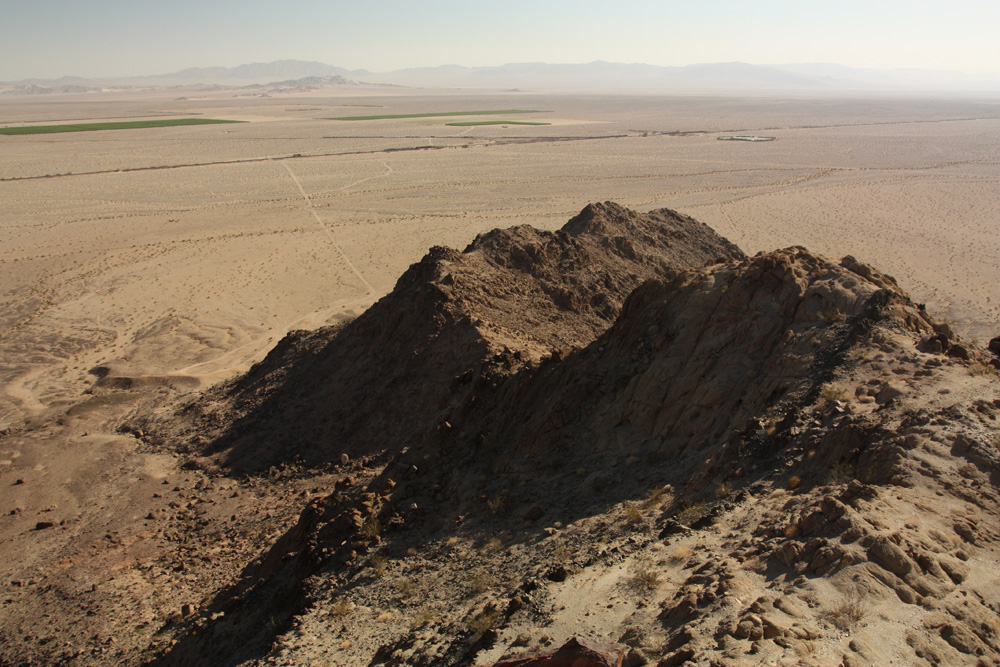
While the range is somewhat unimpressive, reaching perhaps 300m above the surrounding alluvial plane, the sheer “desertiness” of the areas was quite spectacular. Here’s a view from near the top of the mountain.


The green patches in the distance are irrigated fields managed by Cadiz Inc., the only local employer. The tan areas are amalgamated alluvial fans which mantle the mountains.

The rocks were very well exposed, but unfortunately I had to climb to the top of the mountains to get a good look. Normally I wouldn’t shy away from a bit of climbing but it was 4:00 and 43 C when I left camp. Here’s the unconformity between the underlying Proterozoic porphyritic granite and the basal sandstones of the MMWCF.


Very nice desert varnish on the rocks makes it easy to see variations in bedding and grain size. Here’s a shot of some very nice cross lamination.


I random camped on BLM land at the foot of the mountain. This would be a terrible place to camp if it rained. Thankfully there wasn’t a cloud in the sky all day.


They always say that deserts get cold at night. This has not been my personal experience. It was insufferably hot until about 1:30 AM and then just miserable until around 5:00. I did not sleep well and decided that in hot weather a roof top tent would be better than being in the vehicle. I wonder if I could convince Trish…..

Saturday, 9 June 2012

Payson, Arizona


Today I drove through some of the most spectacular desert scenery between Tucson, AZ to Payson, AZ. I decided as usual to forgo the most direct and fastest route and picked a direct line through the heart of Tonto National Forest and the Superstition Mountains. The most direct route is the Apache Trail, or Arizona route 88, a narrow, steep, twisty road which starts off paved and later becomes gravel. The paved section was a hoot and I enjoyed the performance handling my Land Rover had to offer. The gravel part was a 22 mile misery of washboard and badly corrugated road surfaces. The scenery was spectacular though.

The trail runs along the side of three reservoirs. The first and smallest is Canyon Lake held back by the Mormon Flat Dam. Here's a shot, unfortunately with power lines.


The second is Apache Lake, which unfortunately I didn't take a picture of. Here's a shot of the road just beyond Canyon Lake. One of the few places they provide a railing to prevent you going off the shear cliff to the left.


Further up, mercifully at the end of the gravel section, you reach the spectacular Roosevelt Dam. Originally built from stone around the 1910's the dam was at the time it was completed the largest stone dam in the world. The dam could not handle the largest conceivable flood that could occur in its watershed so in the 1990's the dam was enlarged using concreted to increase the capacity of the reservoir. Here's a shot of the downstream side of the dam.


Here's the upstream side with the stone original dam visible above the waterline.


To get to Payson you must cross the Salt River. In the 1990's when they were improving the dam they built the largest single span, steel arch bridge in North America. Very pretty bridge.


Payson is a small'ish town lying at the geographic center of Arizona and just south of the Mogollon Rim, the southern edge of the Colorado Plateau. Despite its mundane appearance the town is a tourist destination due to its location within Tonto National Forest and its proximity to the rim. I elected to stay in the Houston Mesa camground run by the national forest.

Today I was looking at the Tapeats Sandstone where it is exposed at the East Verde River just North of town. Here's a great shot showing the basal unconformity, climbers for scale. The uconformity between the Tapeats Sandstone and the crystalline basement in just above the tops of the trees at the base of the cliff.


I disgorged the contents of the Land Rover onto my site to reorganize. I'm at 24 samples now. Probably close to 500 lbs of rock. They're in the plastic bags. It will soon be difficult to get it all in and organised.


I'm off toward California tomorrow. My next sample location is in the center of the Mohave Desert and I'm a bit worried. This will be the hottest and potentially the most miserable sample location. It's probably too long a drive for one day so I will likely camp just short of California tomorrow and nip in early Monday morning.


Thursday, 7 June 2012

Silver City, New Mexico (a.k.a. Cactus Land)

I'd love deserts, If it weren't for the heat

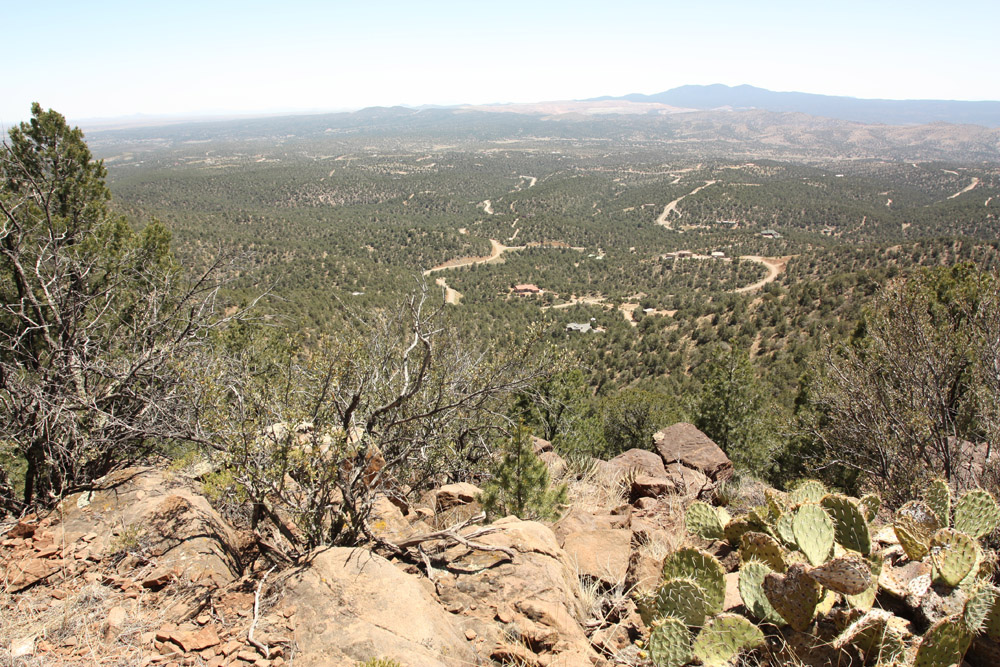
I drove the last 98 miles from Elephant Butte Lake State Park to Silver City, NM this morning. In the spirit of avoiding interstates and taking the most direct route between sample locations I took Hwy 152 through Emory Pass. At 8,828 ft Emory Pass pales in comparison to Hargeman Pass (11,960 ft) but may be the most beautiful drive I've ever done in North America. I actually laughed aloud as the road switched back and forth, back and forth up the pass. Here's the view from the top.


In the middle distance is the old silver mining town of Kingston, which sprung up in the late 1880's only to be abandoned in 1893 when silver prices fell. 

Mining remains a major component of New Mexico's economy. Silver City itself was incorporated in 1870 following the discovery of silver in the area. Today, the Santa Rita Copper/Molybdenum mine forms the basis of the local economy, providing some 1250 jobs (Silver City's population is only 10,000). The town's "Historic Downtown" is quire reminiscent of other western towns I've been through lately.


Here is Javalina the coffee shop I visited this morning while waiting for the Gila National Forest to finish my permit. The building was built in the late 1800's.


The decor was more modern.


The first serious mining at Santa Rita began in 1909 when a rail line through the area made economical shipping of ore possible. The mine is an open pit over a mile across. Here's a shot from the observation area.


Here is another shot from near the continental divide at my sample location. You can see the mine in the distance. Also a good shot of New Mexico.


Today I was describing and sampling the Bliss Sandstone in the Silver City Range right at the continental divide. The area was rife with cacti off all varieties. My personal favourites were the Perry's Century Agave and the Pin Cushion. Century Agave on first then the Pin Cushion is on the right of the second picture. Also shown are prickly pear cacti.


The geology looked much the same as previous locations. Sandstones overlying, in this case, proterozoic granites. The only major difference was the occurence of ironstones. I have to admit I don't know much about ironstones. I will have to look them up. Here's a photo of one.


I decided I'd include a self portait today. I'm always behind the camera so I rarely get to be in my blog.


Tomorrow I head for Tucson to stay with a collaborator for a night. Then on Saturday I'm off to Payson, Arizona. Silver City was my most southerly sample location. It's all west and then north from here!

Wednesday, 6 June 2012

Elephant Butte Lake State Park, New Mexico

Today I drove. No geology or anything particularly interesting occured. My next sample location is near Silver City, NM and my intention was to drive all the way to Silver City today. However, after 7 hours of driving, with the last 4 being on an interstate, I decided I'd had enough and pulled in to Elephant Butte Lake State Park. The Park is centered on a large reservoir created in 1916 to control water flows in New Mexico, Texas and Mexico. Here's a shot of my capsite, you can see the reservoir below.


I must try to plan my days more carefully as driving great distances in Grover and feeling good at the end appear to be incompatible. Perhaps I'm pushing too hard.

Tomorrow I'm taking a short drive over to Silver City and will do my sampling there. Friday I will head to Tucson to stay with a collaborator on this project. Should be nice to sleep in a bed and maybe eat some good food.

The Details of Grover's Recovery

This post is for gear heads. I'm not going to simplify or gloss over details. Here's what Grover needed to be perfect.

Grover has a relatively new engine. While the engine was originally manufatured in 1959, or thereabouts, it was completely overhauled in 2011. As such the engine effectively has about 5000 miles on it. It had, in the past, run well but was plagued by a persistent but not constant missfire. I had for a long time suspected a minor electrical or carb tuning issue but never worked particularly hard to diagnose it. As my trip progressed it got worse to the point where at idle it had nearly a dead-miss on the number 4 cylinder and an intermittent miss on 3.

In Glenwood Springs, CO I started the process of correcting it. As my time at the moment is precious I decided to go the expensive but very diagnostic route of replacing virtually the entire ignition and induction systems. On the electrical side I replaced the rotor, distributor cap, wires and spark plugs. The distributor is electronic so no points or condensor to worry about. I also replaced the carburettor as the old one was dripping fuel from the accelerator linkage. I had previously moved from the mechanical fuel pump to an electric one to remove the possiblity of a failed fuel pump causing issues.

All of these changes had no effect on the engines performance and the miss persisted. GRRRRR.

As I mentioned on Monday, I had discovered an intake manifold vacuum leak. Vacuum leaks are typically diagnosed by spaying a petroleum distillate on potential leak sites and observing a change in engine rpm. This is exactly what I found when I sprayed the 3-4 cylinder intake manifold. I also suspected an exhause manifold leak because you could hear puffing and chuffing exhaust sounds at certain throttle settings (although this may have been a front pipe to manifold leak). The exhaust and intake manifolds use the same gasket. The idle issue I was having could very easily be caused by a vacuum leak so this was a postive development to identify something that could fix the problem.

On Tuesday morning I was trying to decide whether to drive to Silver City, NM, about 430 miles, or whether to attempt to fix the manifold gasket in Durango. Unfortunately I did not have a manifold gasket with me, something I will likely carry on future trips, so I would have to make a new gasket or wait a few days and pay a boat load of money to have one shipped. I went by Napa and purchased a sheet of exhaust manifold gasket and some copper coat and copper antisieze.

Exhaust manifold gasket is not like most other gaskets on a vehicle due to the extreme heat they experience. They typically are a fibre gasket with a metal core. This makes shaping a gasket from a blank sheet non-trivial as you are dealing with a composite material with a relatively thick metal core. I decided to invest in a Dremel to make the cuts.

Now I had my gasket material and a Dremel from Home Depot I need to find a place to work. You can't just do this level of work in a parking lot or on the side of a road. Coming out of the Home Depot parking lot I noticed on a hill just to the south an industrial building with a bunch of Jeeps parked in the lot. I decided to check it out. This would turn out to be the one of the luckiest decisions of my life (maybe a bit dramatic but that's how I feel about it today).

The industrial building was home to 4x4 and More, a local mechanics shop which specializes in offroad vehicles. Here's a link to their website.


www.4x4andmoredgo.com

I plead my case to the owner Lance. I just needed a place to do the work and I had my own tools and parts. He agreed and I set up shop. You can't just work in the full southern Colorado sun, your tools get too hot to use and you fry. So I set up my tarp as a shelter over the left front side of the truck.


I dug into the manifold and within an hour and a half had it disassembled. Here's a shot of the disassembled manifolds.


Unfortunately I found something no mechanic ever wants to see. Someone had put an incorrect bolt in the manifold. Right size, wrong thread. Now I don't want to sound bitter, but I paid good money for the engine rebuild and they put this bolt in the manifold? Words will be had with the shop responsible. Correct bolt on the right. You can see the mangled thread on the bolts that were the incorrect thread.


I ran a tap through the holes that had the wrong bolts and everything bolted up fine in the end. Seems that the metal in the head was harder than the bolt and the bolt suffered the damage.

Now I began the process of forming a gasket from the flat sheet of material. In this photo you can see the original gasket which has been traced onto the new material and I've begun to cut it out.


I used a cutting wheel, essentially a miniature grinder, to make straight cuts which approximated the shape of the outer edges of the gasket. I then used a technique I'd seen once on Youtube to cut the ports for each intake and exhaust runner. You hold the Dremel so that the cutting wheel makes a low angle to your workpiece and then cut at an angle through the workpiece so that the curve of the wheel matches the curve of the hole you want to cut. I then used various grinding and sanding attachments to smooth everything out and adjust the shape to perfectly match the old gasket. I then used a punch set, graciously provided by my hosts, to cut the bolt holes and locating pegs. Here's a shot of the final product.


Interestingly I ran the Dremel for probably an hour and a half off an inverter plugged into my auxilliary battery. Amazing how much energy is stored in a big lead acid battery.

I then began the reinstallation procedure for the manifolds. Land Rovers have a two piece manifold with intake and exhaust manifolds bolted together below the carburettor. The rusty looking one is the exhause manifold, the brighter one the intake. According to the Repair Operations Manual for the Series trucks, also referred to as "The Green Bible" the two manifolds should be first bolted to the head and then bolted together. This had apparently never been done for this manifold as the two were solidly fused together and had an original, metal gasket between them. Bolting the manifolds in the incorrect order can lead to improper mating and leaking manifold gaskets. This is likely exactly what occured with Grover. When I disassembled the manifold I found the faces of the intake and exhaust manifolds to be up to a sixteenth out of alignment. Interestingly this was also where remnants of the old gasket remained on the manifolds.

After reinstalling the manifolds, carburettor and alternator I fired it up to find no significant improvement at idle. At this point I was quite grumpy and it was the end of the day.

Thankfully at this point the fellows of 4x4 and More were done their day and came out to see how I'd faired. They quickly ran through the list of diagnostics attempting to determine the source of the miss. Eventually we rechecked the valve clearances, which I had set in Pincher Creek on my drive South, to find them a bit tight particularly on the number 4 intake which was the cylinder giving me the most trouble. After adjusting them properly (apparently a skill I will need to practice!) the engine was running much better but still randomly missing.

Next was timing. The timing marks on my Rover are quite inaccessible and require a good half hour of disassembly to see. They used a different method to set the timing, one with which I am unfamiliar and will have to read up on involving a vacuum gauge on the carburettor. After finding the engine approximately 15 degrees too far advanced and correcting the problem the engine ran perfectly. I don't mean just good I mean perfectly.

Enough said. A big day of work to correct numerous problems and the final outcome could not be better. I cannot say enough good about the fellows at 4x4 and More. The owner Lance and all the staff were welcoming, accomodating and extremely knowledgeable. If you are ever traveling through southern Colorado and need help, this is your shop. Now to go to the beer store to purchase some remuneration.